A New Framework for Measuring Social Cohesion in Australia
A network-based diagnostic for the durability, inclusivity and quality of Australian society
Australia, like most western democracies, monitors social cohesion through annual surveys of individual attitudes. After shocks such as the Bondi attack of December 2025 or the Southport stabbings of July 2024 in UK, policy-makers need to know not only how individuals feel, but whether the relational fabric of society is holding together. Working under the Australian Resilient Democracy Network, with Matteo Vergani (Deakin), Rouven Link (Scanlon Foundation Research Institute), Simon Angus (Monash), Melanie Rayment (NSW Premier’s Department) and Nicholas Biddle (ANU), we propose a network-based framework that turns social cohesion into a measurable, system-level diagnostic.
[Discussion Paper 17 - Conceptual Fragmentation] [Discussion Paper 18 - Towards a Shared Measurement Framework] [Substack Summary]
Context
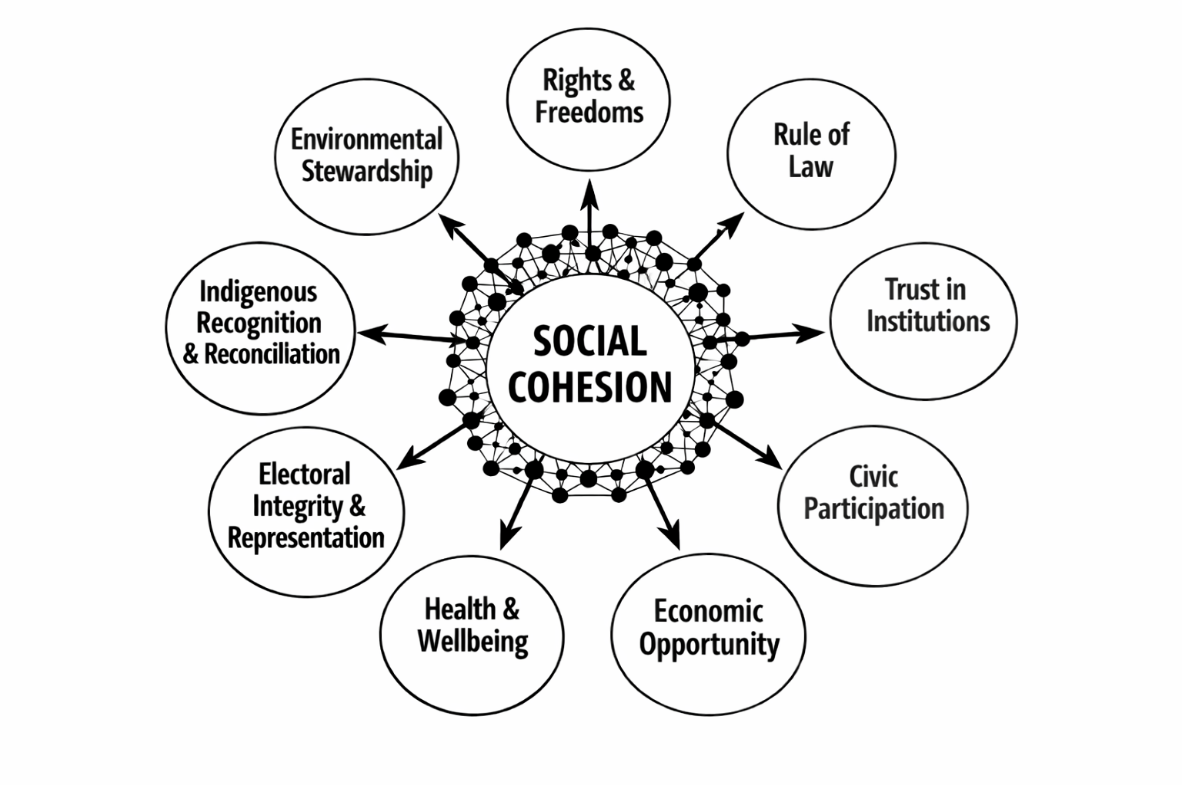
Social cohesion is a flagship priority for Australian governments and a recurring objective in counter-terrorism, immigration and community programs. Yet its measurement is anchored almost exclusively on annual surveys of individual attitudes (e.g. the Scanlon Index of Social Cohesion, the Bertelsmann Social Cohesion Radar, the German Social Cohesion Panel, COES Chile). These instruments are useful for tracking sentiment, but they cannot diagnose the structural drivers of cohesion, identify early-warning signals, or guide place-based and programmatic interventions. As the December 2025 Royal Commission on Antisemitism and Social Cohesion makes plain, the policy demand for a system-level lens is now acute.
Aims
We re-define social cohesion as a property of the relationships across society - not just an aggregation of individual attitudes - and we operationalise that definition into a measurement framework that complements (not replaces) survey instruments. Specifically: "a condition in which people, groups and institutions with heterogeneous identities, views and preferences are connected through durable, inclusive, high-quality relationships that enable collaboration towards collective goals across the whole of society".
Methodology
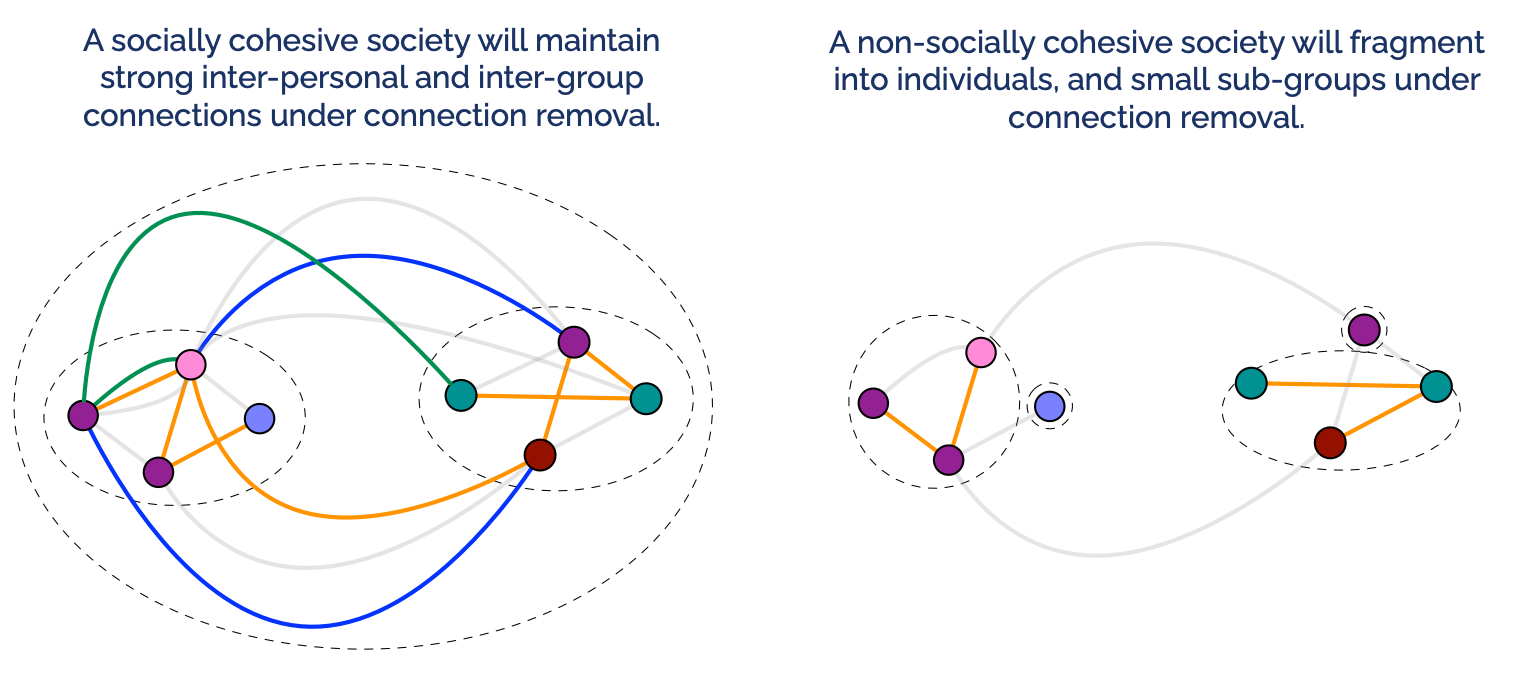
The work is delivered as two papers in the Australian Resilient Democracy Network Discussion Paper series. Paper 17 audits five international measurement programmes and Australian policy frameworks, and shows where conceptual fragmentation translates into inconsistent operationalisation and policy mis-fit. Paper 18 develops a multilayer "super-network" architecture that combines surveys with social-media interaction networks, administrative datasets (PLIDA, BLADE), citizen-engagement records and large-scale public-discourse data. Cohesion is then measured along three dimensions: durability (network connectivity and robustness to tie removal), inclusivity (porosity across categorical boundaries), and quality (collaborative orientation toward collective benefit).
Key Findings
- Definitional fragmentation has measurable policy costs. Across Commonwealth and state frameworks of the past decade, the same word covers belonging, trust, mobility, resilience, and security - producing siloed indicators and inconsistent program design.
- Surveys alone cannot diagnose causal drivers. National annual surveys describe sentiment but cannot tell governments why cohesion broke down in a particular place, or what intervention would restore it.
- Network, administrative and discourse data unlock early-warning capability. Social-media interaction networks (in the spirit of Chetty et al., 2022 on social capital), PLIDA/BLADE, service-interaction records and large-scale discourse analysis make it possible to monitor cohesion at sub-annual frequency and at sub-national resolution.
- Cohesion is distinct from social capital. Strong bonding capital within a sub-group is compatible with low cohesion at the societal level - a distinction that matters for programs targeting "tight" but exclusionary communities.
- Cohesion is not always positive. Highly internally-cohesive groups can be exclusionary or extremist; the framework therefore evaluates inclusivity and quality alongside durability.
Policy Implications
- Decisions about enabling conditions: service quality, procedural fairness and the design of physical and digital civic spaces directly shape whether networks are inclusive, accessible and trusted.
- Decisions about structural stressors: housing insecurity, precarious work and unequal access to essential services weaken bridging ties; they can be tracked alongside cohesion indicators within the same framework.
- Decisions following events and disruptions: after a shock, the super-network view makes thinning of bridging ties and amplification of harmful narratives directly observable and therefore controllable.
- Decisions about program effectiveness: the framework supports both monitoring and evaluation, allowing programs to demonstrate their effect on cohesion rather than only on individual attitudes.
Future Research
- Decision-focused workshops with policy-makers, community leaders, NGOs, service providers and researchers, to validate that the framework improves real decisions across the policy cycle.
- Three measurement pilots in 3-5 strategically selected locations: (i) social-cohesion network mapping using aggregated social-media data; (ii) a public-narratives and social-media observatory leveraging large language models; (iii) a local administrative-data partnership with selected councils.
- An evaluation and governance pathway aligning Commonwealth and state evaluation frameworks so that programs across portfolios can be assessed against the same cohesion architecture.
Main Team:
- A/Prof Matteo Vergani, Deakin University (matteo.vergani@deakin.edu.au)
- Dr Andrea Giovannetti, Australian Catholic University (andrea.giovannetti@acu.edu.au)
- Rouven Link, Scanlon Foundation Research Institute
- Prof Simon Angus, Monash University
- Melanie Rayment, NSW Premier's Department
- Prof Nicholas Biddle, Australian National University
- Alex Fischer, Australian National University