Home Affairs - Countering Violent Extremism (Phase 2)
Network dynamics of online hate in post-7 October Australia
This is Phase 2 of the National Countering Violent Extremism Research Project, funded by the Department of Home Affairs. In this project, we document and decompose the surge in online antisemitic and Islamophobic hate in Australia following the Hamas attacks of 7 October 2023 - and we show that the post-7-October hate ecosystem is built around the pre-existing one.
Context
Following the Hamas attacks on Israel on 7 October 2023 and the subsequent war, Australia recorded a sustained surge in reported online Islamophobic and antisemitic incidents. Public reporting documents the surge but is silent on the complex processes operating in the background: who drives the hate, how the audience changes, and whether the post-7-October ecosystem is a continuation of the pre-existing one or a fundamentally new phenomenon. This project answers those questions with a unique, multi-year dataset.
Aims
We deliver to the Department of Home Affairs an empirical, network-level account of the structure and evolution of online antisemitic and Islamophobic hate in the Australian X/Twitter ecosphere; we identify the small subset of users who carry most of the hate flows; and we test whether the post-7-October surge is built around incumbent users or driven by newcomers.
Methodology
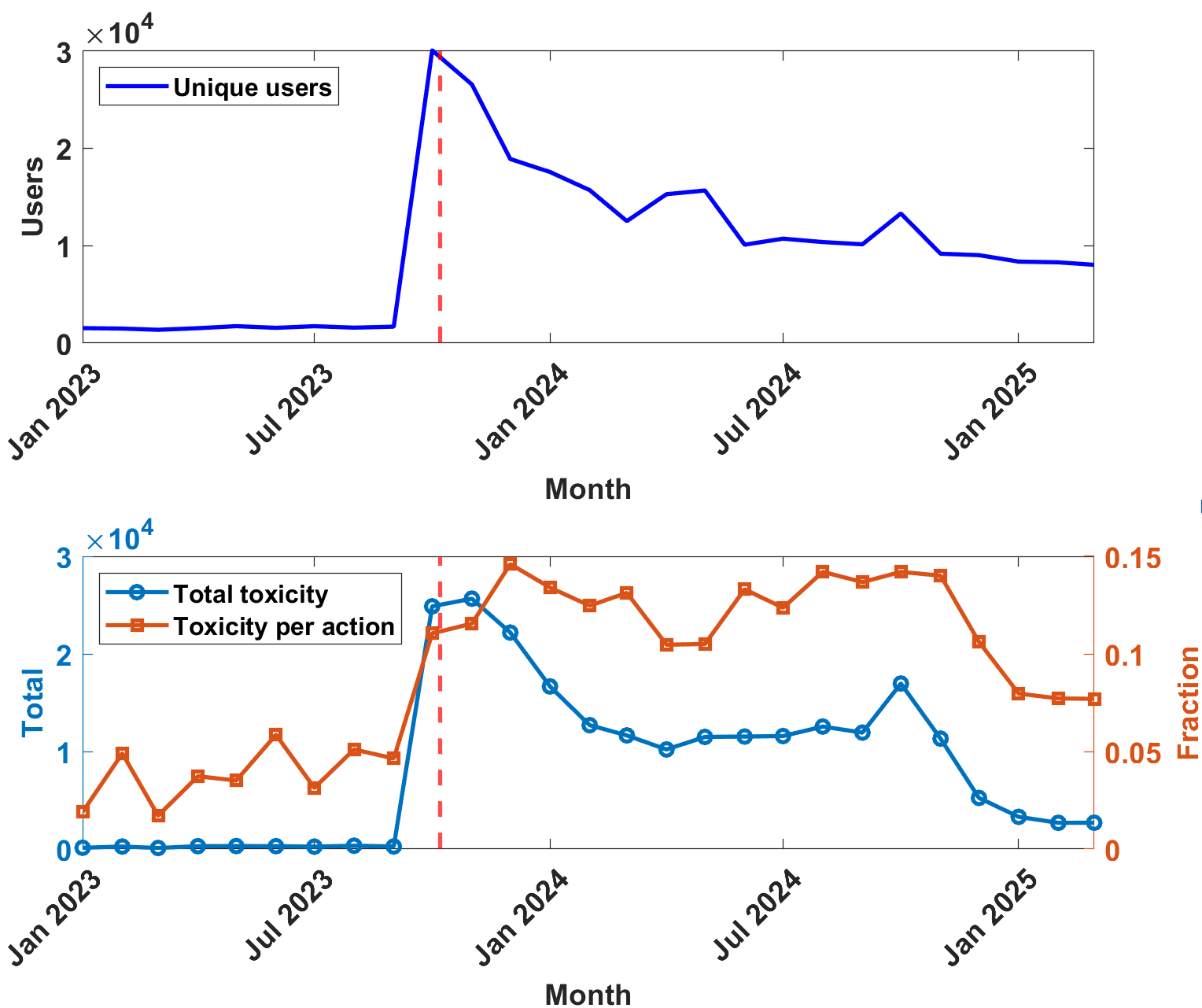
We assemble a unique panel of 1,926,376 actions (posts, shares, replies) by 100,542 Australian-based users, covering October 2022 through March 2025. Collection follows a curated lexicon of more than 200 keywords and combinations capturing antisemitic and Islamophobic discourse. Each message is scored for toxicity via the Google Perspective API. We treat the resulting graph as a directed influence network where an edge from user i to user j records that j reacted to a post by i. Community detection groups users that share narratives, and pre/post-7-October comparisons isolate the change in network structure attributable to the shock.
Key Findings
- The surge is real, sustained, and qualitatively different. The number of users producing hate quintuples and toxicity per message jumps and stays elevated for at least 18 months after the shock.
- Incumbents - not newcomers - drive the toxicity. Users active before 7 October 2023 score on average 6.6× higher in toxicity than users who entered the ecosystem after the shock.
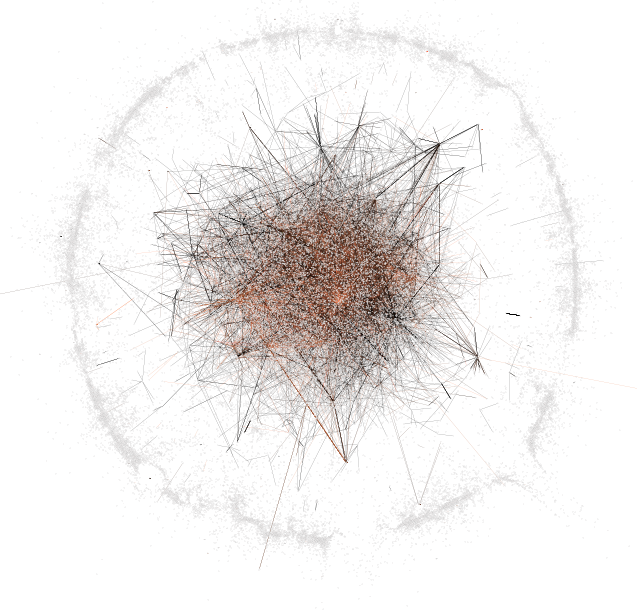
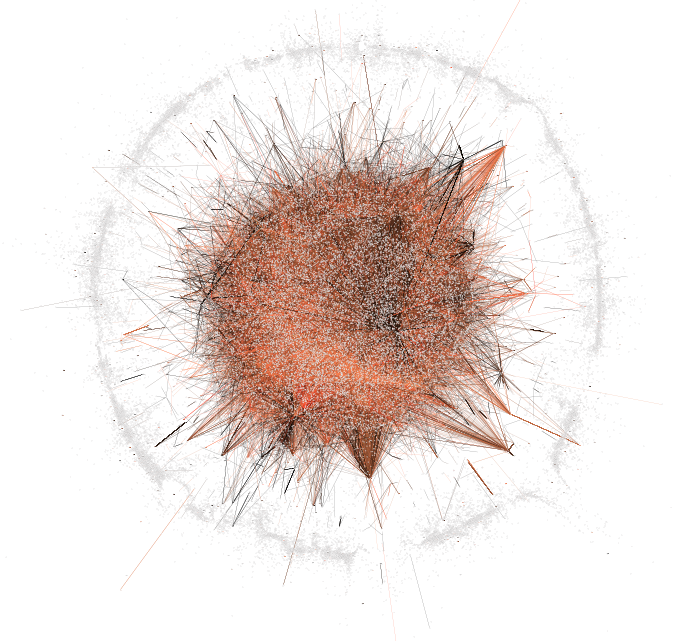
- The post-shock network expands around the pre-shock cores. 72% of the pre-7-October incumbent nodes remain linked together as the network grows; the surge is structurally a scaling-up of an existing ecosystem, not a new one.
- Influence concentrates in a small group of accounts. The number of influencers rises from 1,401 to 7,401, but their share of links rises from 2.33% to 97.31% of the eventual graph - a textbook example of preferential attachment at work in a hate ecosystem.
- Centrality and toxicity are persistent. Users who were toxic and central before the shock remain toxic and central after, with strong substitution between toxicity and popularity at the very top of the distribution.
Policy Implications
- Monitor the incumbent core, not the newcomer surge. The empirical leverage of post-shock interventions is concentrated on a small, identifiable set of pre-existing users.
- Differentiate surge dynamics from baseline. Annual reporting indicators that count incidents miss the structural shift; network-level monitoring is the operationalisable alternative.
- Use toxicity-weighted, not volume-weighted indicators. Since toxicity per action and not just total volume changes after the shock, action-level scoring is necessary for accurate situational awareness.
- Cross-platform transferability. The methodology generalises to Telegram, Bluesky and other emerging platforms where Home Affairs and AVERT have growing monitoring needs.
Deliverables
- Public report hosted on Deakin Research Online: Unveiling Influence Flows in Online Anti-Jewish and Anti-Muslim Hate in Australia.
In the Media
As principal investigator, I discussed the findings of this work in the national press. See the media page for the full list, including:
- Online hatred spiked after the Bondi massacre: Meta knows why — The Sydney Morning Herald.
- Meta to front royal commission to answer for the role media has played in amplifying hate — The Age.
Team:
- Dr Andrea Giovannetti, Australian Catholic University (lead) (andrea.giovannetti@acu.edu.au)
- A/Prof Matteo Vergani, Deakin University (matteo.vergani@deakin.edu.au)